Containers staged for drilling and completion debris, then again for site cleanup once the pad comes off production. If there's a pit liner to pull, that's a separate scope with its own handling, and we do that work too. See oilfield waste disposal and frac pond liner removal.
A spread moves, so the containers and the sanitation move with it. We stage units along the right of way and reposition them as the crew advances, so nobody loses half a shift driving back to a fixed point. See pipeline construction rentals.
Sanitation at a scale that needs a service schedule rather than a weekly stop: portable toilets, large quantity holding tanks, water supply, and pump outs on a cadence you set. We carry adapters that connect to shower trailers, kitchen trailers, and living quarter trailers already on your site. See man camp services.
Short notice, several work zones running at once, and a volume curve that spikes and then drops. We'll set container counts by zone and add units as the scope grows, which it usually does. See container sizes and portable toilet rental.
If you're also running commercial builds in Midland or Odessa outside your energy scope, the same account covers those. See construction dumpsters.
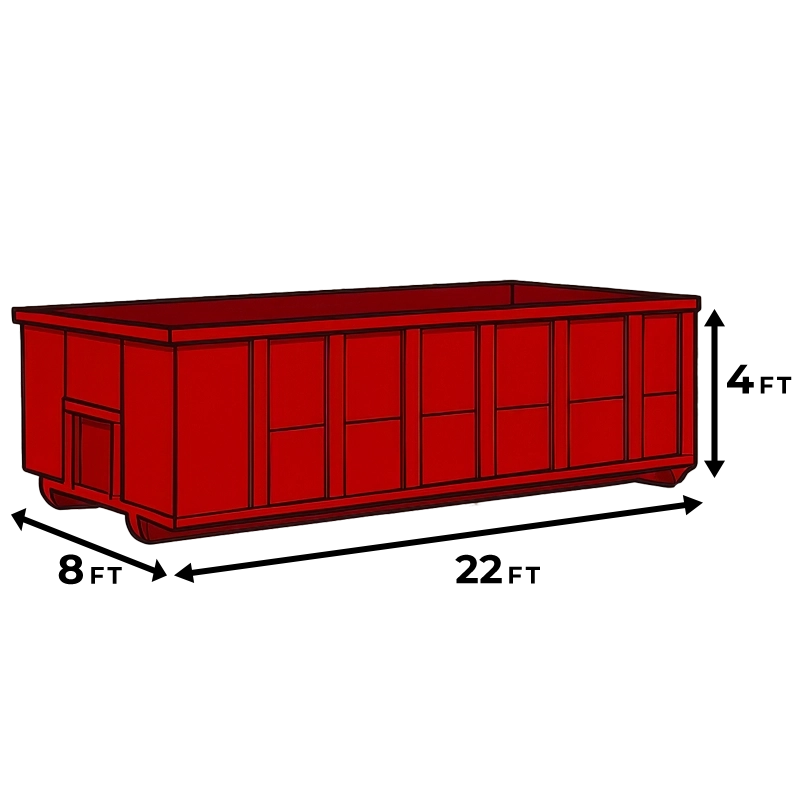


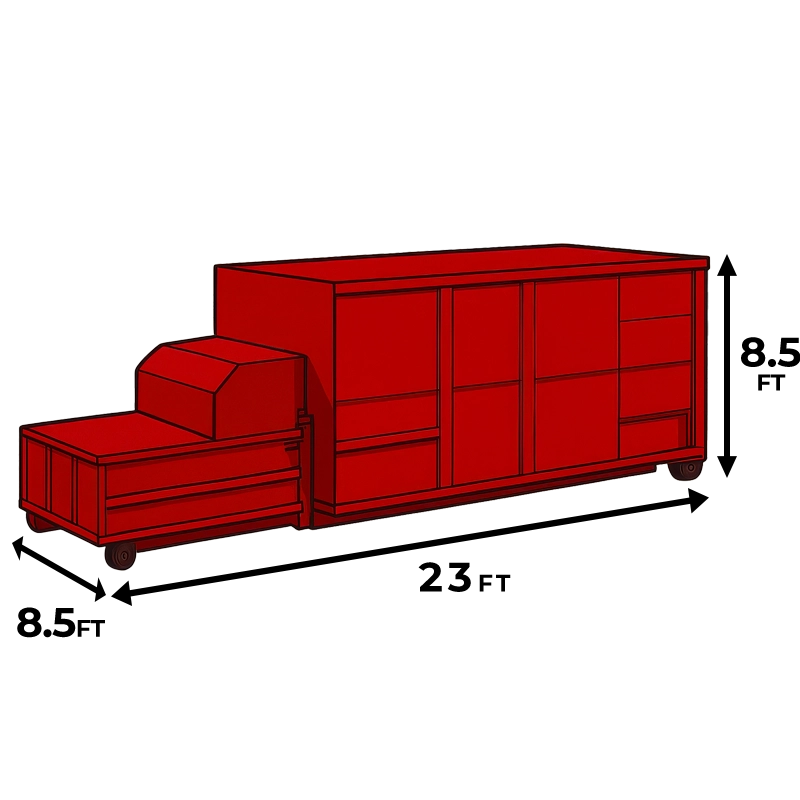
Alongside the containers, the sanitation lineup this segment actually uses:
Portable toilets and ADA units. Standard units for crews, ADA compliant units where the site needs them. Unit counts on an oilfield site are driven by OSHA's requirements, which we break down in our guide to oilfield portable toilet requirements.
Large quantity holding tanks. Above ground waste storage, drop off only, no plumbing. This is what a camp or a long duration site runs on when there's nothing to tie into.
Pump outs. Scheduled as often as the site needs, up to several times a day, seven days a week.
Fresh water and non-potable water tanks. Water supply for crew operations, delivered and refilled on the same schedule as everything else.
Battery-operated pumps. For sites with no power source, so a camp doesn't need a generator running just to keep the sanitation serviced.
Handwashing stations, shower trailers, and cage trash trailers. The rest of the crew footprint, available as a combo with the portable units.
There's no standard package for this work. Crew size, site layout, duration, and what equipment is already out there all change the answer. So the first conversation is about the site itself, and the container count falls out of it.
Access road, turnaround room, where the crew actually works, and what the ground does after rain. Getting this wrong costs a second trip.
Containers and sanitation land together, from one dispatcher, on a date we give you before the truck leaves the yard.
Pump outs run as frequently as the site requires, up to seven days a week. Containers get swapped as they fill, which means we pick up the full one, haul it, and drop an empty in the same spot so nobody stops working. The replacement is a separate rental.
Anything requiring classification comes out of the normal container flow before it moves. That process is in the next section.
Final container, final pump out, units off the site. If there's cleanup work after the crew leaves, that gets scoped separately.
Some of what comes off an oil and gas site can't go in a roll-off with everything else. Contaminated soil, sandblast media from coating and painting operations, and other Class 1 and Class 2 non-hazardous special waste all have to be classified before anyone can legally move them.
At the level you need it to make a decision: you arrange a TCLP test. We can help you line up a testing partner, though we don't run the test ourselves. The results classify the material. If it comes back Class 1 or Class 2 non-hazardous, we set up a waste profile and haul it to the correct facility under Railroad Commission of Texas requirements.
If it tests above Class 2, we tell you, and you'll need a specialized hazardous waste hauler. We don't move material we aren't permitted to move, and we'd rather say that on the phone than on the site. The full process, including what the testing timeline does to your schedule, is on the contaminated soil cleanup page and in our guide to contaminated soil disposal in the Permian Basin.
Most container companies in this basin can handle general debris and nothing past it. These are the credentials that change what we can put on a truck, and what each one means when you're the operator signing the manifest.
| Credential | What it means for your site |
EPA ID TXR000083663 | We're registered to transport solid waste, which is the baseline for anything leaving a regulated site |
Railroad Commission of Texas registration RN109046839 | Our authorization sits with the same agency that oversees your operation |
Industrial and Hazardous Waste transporter registration (SWR 96263) | Authorizes transport of Class 1 and Class 2 non-hazardous industrial waste. The program name includes the words hazardous waste. That's the name of the program we're registered under, not a description of what we haul. The line stays at non-hazardous |
Contaminated soil hauling license from the Railroad Commission of Texas | This is the one that lets us take contaminated soil at all. It's the credential most of our competitors don't hold |
PEC certified operations managers | Our operations managers hold it, so the people scheduling your site understand the safety environment they're scheduling into |
Full detail on every permit and registration we carry is on our permits page.
The landfill in Odessa where a lot of this material ends up is owned by our parent company. We do the haul, that facility does the disposal, and the two sit inside one connected operation, without a handoff to a company neither of us controls.
If your material is going to get looked at later, that matters. It also means that when you need to know where a specific load went, you're asking one operation instead of chasing a subcontractor's paperwork, so ask us at the time of the haul and we can tell you.
Credentials competitors can't match. The contaminated soil hauling license is a real barrier to entry. A hauler either holds it or has to turn the work down, and most of the container companies working this basin have to turn it down.
One provider for the whole site. Containers, sanitation, water, and special waste on one account and one dispatcher. When the schedule slips, there's one person to call, and that person can see the whole site.
PEC certified operations managers. Certification sits with the people who run the scheduling and the site planning.
Over a decade in the Permian Basin. We know which lease roads wash out, which yards are close to which counties, and how long it actually takes to get a truck to a site an hour past the last paved road.
Around-the-clock availability. The line is answered outside business hours by coverage staff. Call 800-996-9862.
“Booked a big ol' dumpster online, easy as pie. Arrived on demo day, clean and strong enough for all the bricks and shingles. Crew filled it fast, no overflowing mess. One call later, West Texas Dumpsters hauled it away next day, leaving my driveway spotless. No hidden fees, just fast, professional service. Saved me tons of trips to the dump and backaches. West Texas Dumpsters' Construction Dumpsters - my new best friend for future renos!”
Kyle F.
“Service has been great! It's refreshing to work with such an organized and professional group! Even when we give them last minute notice, they get us taken care of! Thanks for the flexibility and continued good communication!”
Rhiannon S.
“I would recommend. Great customer service, easy to get and on time delivery.”
Maritza G.
We run the basin out of Midland and Odessa, and the county level pages are where the coverage gets specific for sites that aren't near either one.
Midland and Odessa are the core. Beyond them we cover Ector County, Reeves County, Pecos, and the rest of the West Texas side of the basin. If your site is outside a town we've named, call. The answer is usually yes, and it depends on how the trucks are routed that week.
Yes, and that's most of what this page is about. Containers, portable sanitation, holding tanks, and water all run through one account and one dispatcher. What drives the quote is the site scope: how many containers, how many sanitation units, how often you need them serviced, how long the job runs, and where the site sits relative to our yards. Call 800-996-9862 with those five things and we can scope it on the phone.
Yes, once it's classified. You arrange a TCLP test, and we can help you find a testing partner. If the results come back Class 1 or Class 2 non-hazardous, we set up the waste profile and haul it under Railroad Commission requirements. If it tests above Class 2, you need a specialized hazardous waste hauler and we'll tell you so. The contaminated soil cleanup page walks the full process.
Yes. Unpaved access is normal for this work and we plan placement around it. For sanitation on sites with no power source, we run battery-operated pumps, so a site doesn't need a generator to keep units serviced. Tell us about the road when you call, not after the truck is already out there.
Yes, across the West Texas portion of the Permian Basin, including the county level coverage on our service areas pages. Remote sites are routine for us. Whether we can hit a specific date comes down to where the trucks are that week, so call and ask.
An EPA ID (TXR000083663), a Railroad Commission of Texas registration (RN109046839), an Industrial and Hazardous Waste transporter registration (SWR 96263), and a contaminated soil hauling license from the Railroad Commission of Texas. Our operations managers are PEC certified. The registrations cover transport of Class 1 and Class 2 non-hazardous industrial waste. The license is what covers contaminated soil specifically.
As often as the camp needs, up to several times a day, seven days a week. The cadence gets set when we scope the camp, because crew size and tank capacity drive it more than any standard schedule would. Detail on the full man camp setup is on the man camp services page and in our man camp waste management guide.
At a permitted disposal facility, and for a lot of Permian Basin material that facility is the Odessa landfill owned by our parent company. We handle the haul, that site handles the disposal, and the two sit inside one connected operation. Nobody outside it touches the load in between.
Tell us where the site is, how long it runs, and what's coming off it. We'll put together the container count, the sanitation setup, and the servicing schedule as one quote, and we'll tell you upfront if any of the material needs testing before it moves.
Call 800-996-9862 or send us the site details and we'll come back with a scope built for that job.
