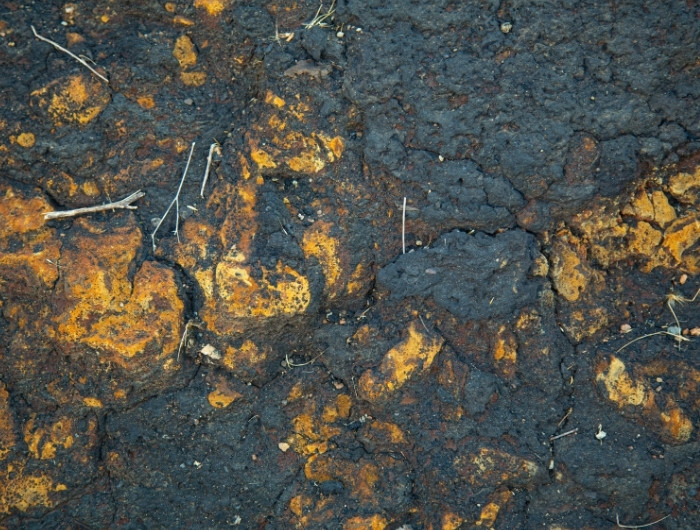
Contaminated soil disposal in West Texas is not a service most dumpster companies are legally able to provide. Hauling soil impacted by hydrocarbons, brine, or other oilfield contaminants requires a specific permit stack: a Waste Hauler Permit from the Railroad Commission of Texas, an EPA ID for waste transport, and an Industrial and Hazardous Waste (IHW) Transporter registration.
West Texas Dumpsters holds all three. For Permian Basin operators dealing with a release, a well site decommissioning, a tank battery cleanup, or a remediation project, the real question is rarely whether the soil needs to leave the site. The question is how the material is classified under Texas rules and what paperwork has to move alongside it.
Contaminated soil is a routine byproduct of Permian Basin oil and gas operations, not an edge case. The most common triggers are well site decommissioning during lease plug and abandonment work, tank battery cleanup after a leak or corrosion event, and spill response following a release from a flowline, gathering line, or storage vessel. Sandblast material generated during coating operations on tanks and pipelines lands in the same regulatory category, even though it is not technically soil. Refinery and compressor station turnarounds also produce hydrocarbon-impacted soil when equipment is excavated or pads are rebuilt.
For Permian Basin operators, the operational issue is almost always the timeline. Getting classification and paperwork moving on day one is what keeps the rest of the site work on schedule.
Every load of contaminated soil has to be classified before it can go anywhere. In Texas, the gatekeeper is the TCLP test (Toxicity Characteristic Leaching Procedure), an EPA-defined analysis that measures how much of certain regulated contaminants would leach out of the soil under landfill conditions. The result determines whether the material is hazardous or non-hazardous, and if non-hazardous, which TCEQ class it falls under.
Per TCEQ Regulatory Guidance RG-022, the three non-hazardous classifications in Texas are Class 1 (potentially threatening, requires more stringent handling and disposal at a permitted landfill), Class 2 (standard non-hazardous industrial waste), and Class 3 (inert materials like rock and clean dirt).
West Texas Dumpsters is licensed to haul Class 1 and Class 2 non-hazardous special waste, which covers the large majority of contaminated soil generated during Permian Basin oilfield operations. If the TCLP results come back showing the soil is hazardous, the material moves into a different regulatory regime that requires a hauler with hazardous waste authorization.
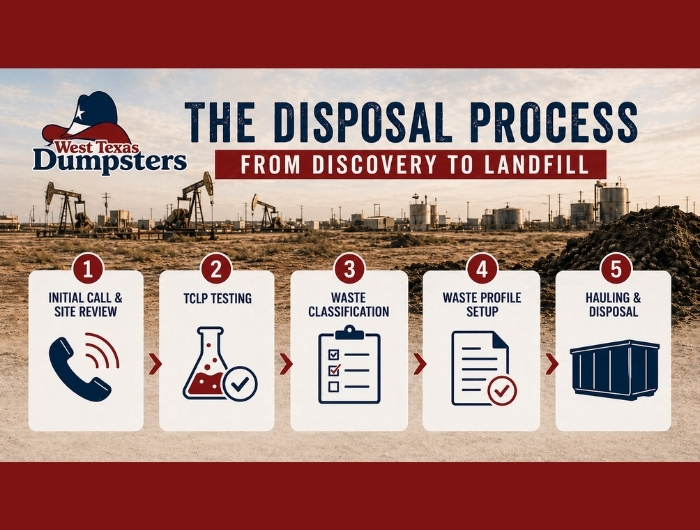
The process from first call to final disposal has five stages, and most of the time is spent on testing and profile setup rather than hauling.
The first step is a call to West Texas Dumpsters at (800) 996-9862 to describe the site, the volume of material, and the known or suspected source of contamination. That conversation identifies what testing is needed and whether a waste profile already exists for the receiving landfill or needs to be built from scratch.
The second step is the TCLP test. West Texas Dumpsters does not perform lab testing, but the operations team routinely coordinates with partner laboratories and can arrange sample collection and chain-of-custody documentation. For operators without an in-house environmental consultant, this is often the bottleneck, and having a hauler that can move the sample through a known lab cuts days off the timeline.
The third step is classification. The lab returns results showing which constituents are present and at what concentrations, and the waste is classified as Class 1 non-hazardous, Class 2 non-hazardous, or hazardous. The large majority of Permian Basin contaminated soil falls into Class 1 or Class 2 and stays with WTD through disposal.
In the rare case, the test classifies the material as hazardous, WTD coordinates a handoff to a properly authorized transporter and continues handling any companion non-hazardous material from the same site.
The fourth step is waste profile setup. The receiving landfill needs a signed profile document describing the material, the generator, the source, and the test results. West Texas Dumpsters handles this coordination with the disposal facility, which in most cases is Diamondback Landfill in Odessa, a TXP-affiliated facility that provides chain-of-custody assurance for compliance-sensitive clients.
The fifth step is hauling and disposal. Once the profile is approved, roll-off containers are delivered, loaded, and transported under a signed manifest. Same-day and next-day container delivery is available across the core Permian Basin service area for urgent work.

A credible hauler for Permian Basin contaminated soil work should hold four specific credentials, and operators should verify each one in writing before signing a contract. West Texas Dumpsters holds all four.
The Contaminated Soil Hauling License is issued by the Railroad Commission of Texas under the agency’s Waste Hauler Permit program. This authorizes the transport of non-hazardous oil and gas waste off the lease where it was generated. The RRC Registration (West Texas Dumpsters’ number is RN109046839) keeps the company under Commission oversight and is a prerequisite for the hauler permit. The EPA ID (TXR000083663) is the federal waste transporter registration required for moving solid waste across jurisdictional lines. The IHW Transporter registration (SWR 96263) authorizes the transport of industrial and hazardous waste under TCEQ oversight, in West Texas Dumpsters’ case, covering non-hazardous Class 1 and Class 2 special waste, including contaminated soil and sandblast material.
The combination matters because each credential covers a different slice of what contaminated soil hauling requires under Texas rules. Verifying the specific permit numbers in writing, not just the general claim of being licensed, is what protects the generator’s paper trail if the disposal is audited later.
Yes. TCLP testing itself is performed by accredited environmental laboratories, but WTD coordinates the testing through partner labs as part of the disposal process. That includes sample collection and chain-of-custody documentation, which keeps the paperwork clean for the receiving landfill. The TCLP report is what drives waste classification and determines the disposal pathway, so getting it routed correctly on day one keeps the rest of the project moving.
West Texas Dumpsters is licensed to transport Class 1 and Class 2 non-hazardous special waste, which covers the large majority of contaminated soil generated by Permian Basin oilfield operations. This includes hydrocarbon-impacted soil from releases, tank battery cleanups, and well site decommissioning, along with sandblast material from coating operations. Material classified as hazardous requires a hauler with hazardous waste authorization.
Hazardous-classified soil requires a transporter with authorizations that go beyond a standard Waste Hauler Permit. For soil of oilfield origin, the hauler must comply with the Railroad Commission of Texas Statewide Rule 98, which governs the management of hazardous oil and gas waste.
For hazardous soil from non-oilfield sources, authority shifts to the Texas Commission on Environmental Quality under RCRA Subtitle C standards, which requires a TCEQ hazardous waste transporter registration and an EPA hazardous waste transporter ID.
In both cases, the driver and vehicle typically need current DOT HazMat certifications, and the disposal facility must be RCRA Subtitle C permitted. Operators should verify these credentials in writing before contracting any hauler for hazardous material.
Timing depends mostly on TCLP testing turnaround, which is typically a few business days with a partner lab. Once classification and the waste profile are approved, transport can be scheduled quickly. For urgent remediation, same-day and next-day container delivery is available across the core Permian Basin service area.

For Permian Basin operators dealing with contaminated soil, sandblast material, or any Class 1 or Class 2 non-hazardous special waste, call (800) 996-9862 to walk the project through with the West Texas Dumpsters team. The conversation starts with site location, volume, and source, and moves through testing coordination, profile setup, and transport in sequence.
Our service is available across Midland, Odessa, Pecos, Monahans, Andrews, Kermit, Fort Stockton, and the surrounding Permian Basin communities.
