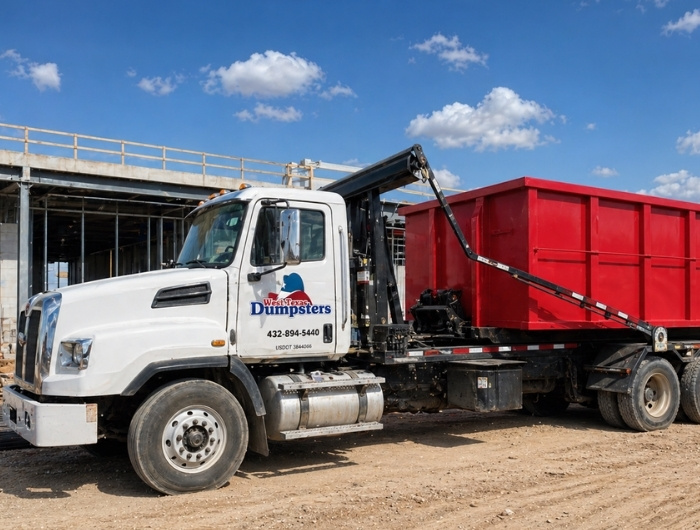
Choosing the right roll-off dumpster size is one of the simpler decisions on a Midland or Odessa commercial build, but getting it wrong adds cost fast. Construction dumpster rental in Midland, TX and across the Permian Basin comes in different sizes.
The right choice depends on debris type, project duration, site space, and weight, with weight being the constraint most contractors underestimate. This guide walks through how to size a roll-off for commercial construction in West Texas, what the 10-ton DOT weight ceiling means in practice, and how the Diamondback Landfill connection changes the disposal equation for Midland and Odessa contractors.
Roll-off dumpsters are sized in cubic yards, which is a volume measurement. A 20-yard roll-off holds 20 cubic yards of debris. A 40-yard holds 40 cubic yards. The container dimensions matter for site fit, but the cubic yard rating is what matches a container to the volume of debris a job is going to generate.
Volume only solves part of the sizing problem. Construction debris weighs different amounts per cubic yard depending on what it is. A 30-yard container filled with light debris (drywall, framing scraps, packaging) might come in well under the legal weight ceiling.
The same 30-yard filled with concrete or masonry rubble will hit the legal weight ceiling long before the volume is full. That mismatch is where sizing decisions get made or missed.
Across all sizes and all WTD service areas, the maximum legal weight is 10 tons (20,000 pounds), the Texas DOT road limit. That ceiling applies whether the container is a 20 yard or a 40 yard. Going over the legal weight risks the haul, the road, and the project schedule.
The 20 yard roll-off is the smallest commercial size offered by WTD. Approximate dimensions are 22 feet long by 8 feet wide by 4 feet high. The lower height is the practical advantage: it lets crews walk debris in over the side rather than carry everything to the back door. That matters on remodel and tenant improvement work where there is no path for a wheelbarrow.
Typical commercial use for this size are medium remodels, smaller demolitions, tenant improvement debris, mixed C&D material on a tight site footprint. If the project is heavy on dense material (concrete pads, masonry, tile), the 20 yard often hits its weight ceiling well before the volume is full. That can still be the right call when site space won’t accommodate something larger.
The 30 yard roll-off is the workhorse size for commercial dumpster rental in Odessa and Midland commercial construction. Approximate dimensions are 20 feet long by 8 feet wide by 6 feet high. The taller wall holds more volume on the same footprint as the 20 yard, which is why it’s the default choice for new builds, major renovations, and multi-trade projects.
Typical use case for this size are large commercial construction, major renovations, multi-floor projects, mixed debris over multi-week durations. The 30 yard is also the right pick when a contractor wants the option to swap rather than scale up. A swap means WTD picks up the full container, hauls it, and drops a fresh one in the same spot.
For a multi-month build, two or three 30 yard swaps will often outperform a single 40 yard staying on site the whole time.
The 40 yard roll-off is one of the largest standard roll-offs available. Approximate dimensions are 22 feet long by 8 feet wide by 8 feet high. This is the size built for high-volume, lighter-density debris: framing scraps, packaging, insulation, drywall offcuts, large cleanouts.
Typical use for this size includes industrial sites, large-scale commercial demolition prep, major cleanouts, high-volume light debris. The 40-yard is the wrong call for dense material. The volume will outrun the 10 ton DOT ceiling almost immediately on concrete-heavy or masonry-heavy work.
Most sizing mistakes on commercial work in the Permian Basin come from picking by volume and forgetting weight. A few numbers from the EPA’s construction and demolition materials data make the math obvious. Concrete debris runs roughly 4,000 pounds per cubic yard. Brick and masonry are similar. Mixed C&D averages 500 to 800 pounds per cubic yard. Drywall, packaging, and lumber are lighter still.
A 30 yard container packed full of clean concrete debris would theoretically weigh 60 tons, six times the legal haul. In practice, a contractor running a concrete tear-out fills a roll-off to roughly five cubic yards of concrete and calls for a swap. The container looks empty. It’s at weight.
The takeaway: pick by the heaviest material first. If the job is concrete-heavy, masonry-heavy, or pulling out tile and stone substrate, a 20 yard or 30 yard with a swap plan is almost always the right answer. If the job is light density (framing, drywall, packaging, fixtures), the 40 yard earns its keep. For mixed projects where heavy and light phases run sequentially, plan to swap container sizes between phases.
TXP, the parent company of WTD, owns the Diamondback Landfill in Odessa. For Midland and Odessa contractors, this vertical integration means tighter scheduling control on the disposal side and chain of custody on what leaves the site. For most commercial work, that’s a logistics advantage.
For projects that touch contaminated material (sandblast residue, oily soil, certain industrial cleanouts), it’s a compliance advantage. The same hauler that picks up the dumpster owns the landfill it’s going to. The credentials behind that disposal authority, including the EPA ID, the RRC registration, and the IHW Transporter license, are documented on the WTD permits page.
Standard dumpster companies operating in the Permian Basin do not own their disposal facility and typically do not hold the credentials required for non-hazardous special waste handling. Most commercial construction never touches that, but for the projects that do, the difference is structural.
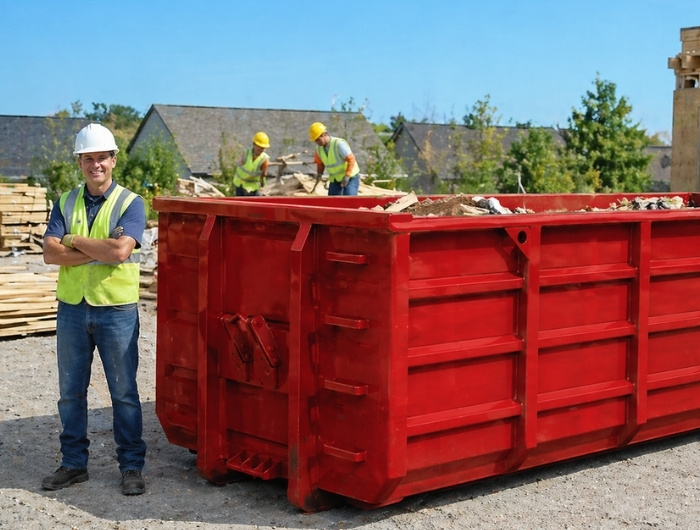
For most commercial construction in Midland, the 30 yard roll-off is the default starting point. It handles mixed C&D debris on multi-week projects and stays within the 10 ton DOT haul weight on typical density. For concrete-heavy or masonry-heavy work, a 20 yard with a swap schedule is usually more efficient. For high-volume light debris (cleanouts, framing-heavy phases, packaging), the 40 yard earns its space. Call WTD at (800) 996-9862 to walk through the specifics of your project.
The legal maximum weight is 10 tons (20,000 pounds), which is the Texas DOT road limit and applies regardless of container size. Going over that ceiling risks the haul itself. Included tonnage in a rental varies by quote and depends on debris type, project duration, and market. Pricing and tonnage allowances are confirmed at the time of quote.
WTD services Odessa, Midland, and the surrounding Permian Basin from local yards. Same-day and next-day delivery are common for standard commercial sizing, with availability tied to current dispatch load. Call the office to confirm a delivery window for your specific job site.
Hazardous waste of any kind, including paint, oils, solvents, chemicals, batteries, tires, propane tanks, medical waste, asbestos, refrigerants (appliances must be discharged first), liquid waste, and flammable or explosive materials. The full accepted and prohibited items list covers the standard categories. Sandblast material and contaminated soil require separate documentation and a different service track. See the contaminated soil disposal guide for projects that involve those materials.
WTD swaps the container. A swap means the full container is picked up and hauled, and a fresh empty container is dropped in the same spot, billed as a new rental. Swaps are routine on multi-week commercial work and are the standard answer for projects that outpace a single container’s volume.
Sizing a roll-off for commercial construction in the Permian Basin comes down to debris type, project duration, and site space. WTD handles construction dumpster rentals across Midland, Odessa, Ector County, Midland County, and the surrounding Permian Basin, with disposal routed through TXPs Diamondback Landfill in Odessa. As WTD’s parent company, TXP helps support efficient disposal for projects across the region.
Call (800) 996-9862 or contact the team to get a custom quote based on your project’s location, materials, and timeline.
